
Free Lessons
Nashville charts
There are two main ways that you see printed music in any studio in Nashville. First, you will see the traditional way where every note is written out for each instrument. That is the way it is typically done when recording an orchestra.
However, most music recorded in Nashville is not recorded by an orchestra. Usually, there are a few rhythm players (drums, guitar, piano) and perhaps a few other instruments (fiddle, mandolin, brass, etc.)
In those types of settings, music is often just notated on a lead sheet, or more typically on a chart where you just see a set of chord numbers. Good improvising musicians do not need anything more than a chart of chord numbers to make nice things happen.
I am not recording an orchestra this time so I am currently knee deep in charts to give to the other musicians. Here is a very simple one that I am recording next week.
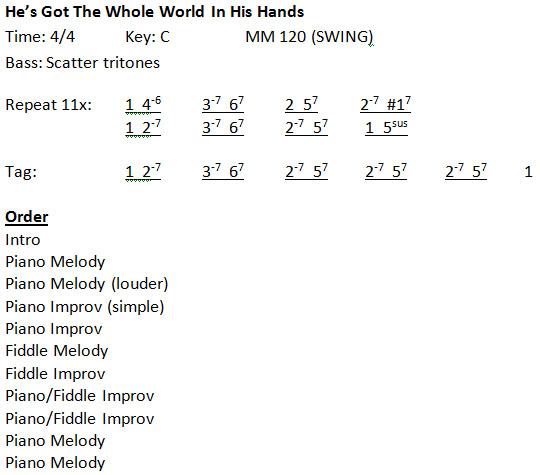
Here are the basics to understanding the chart. At the top, you can get the time signature, key signature and speed. Then you see the chords for each measure notated by number. If there is more than one chord in a bar, a line is drawn under all the chords in the bar.
This chart says to repeat eight bars 11 times and then play the 6 bar tag. Just below the tag, you see what is going to happen each time. The first time through is the intro, the piano has melody the next time, etc.
This is a 3 minute song. You can easily calculate that by noting that there are 8 bars repeated 11 times and each measure has 4 beats. The tag has an additional 6 bars and 24 beats. That makes a total of 376 beats. Divide 376 by 120 (beats per minute) and you come up with 3.13 minutes. Since this song will be played with a click (metronome), it will end up exactly that length.
Some of you might be wondering how a song can be that simple. Can you really record a good song with 8 bars repeated 11 times? Actually you can. Have you heard of Pachelbel’s Canon? It does nothing but repeat 8 bars of very basic chords over and over but it is still one of the most popular classical pieces of all time. For that matter, most hymns are just 16 bars of very basic chords repeated over and over.
Normally, my songs are not this simple. But this particular song is for a different purpose than most songs I record. In fact, I am not actually putting it on a CD. We will just be creating a track I can play with in concerts (I need another upbeat, happy song). Besides me, the musicians will be a bass player, a drummer, and a fiddle player.
One thing I want to point out that does bring variety is the note to the bass player to use tritones. What that means is that whenever he encounters a dominant chord in the chart, he can substitute the dominant a tritone away. He can do it at random without me knowing what he is going to do and it will still work regardless of what I play. Some day, I will explain why that is the case. Those tritone subsitutions will add a lot of color to the song.