
Free Lessons
Changing V-I progressions to ii-V-I progressions
When I recently posted this lesson, I did not go into enough detail to really explain it. Several people emailed me and asked for clarification, so here it is.
A major point in that post was this: if you see a common V-I progression, you can improve it immediately by turning it into a ii-V-I progression. I hesitate to use the word “always” but in reality, you can do this almost always and it will sound great. You also do not really have to worry about overusing this concept.
I also mentioned that this is often done by turning a V chord into a ii-V progression. You can split up the beats on the V chord and change the first part to a ii chord. Here are a few practical examples.
First, let’s consider a phrase from “Trust and Obey” that has a V-I progression in bars 3-4. Now, let’s turn this progression into a I – ii – V – I progression.
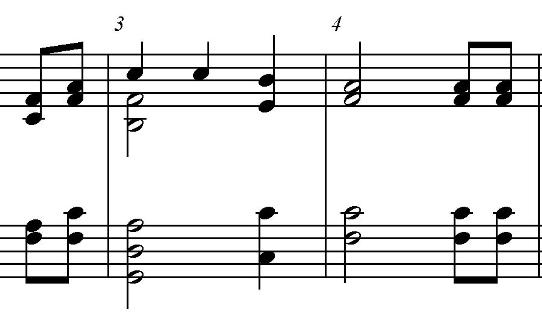
I did this by turning the first two beats of the V chord into a ii chord and leaving the third beat of that measure a V chord. Study this carefully and learn to do this in your music.
Note the interesting voicing (way the notes are played on the keyboard) for the ii chord. That is the way I would normally do it, but there are other options. Just pick something that sounds good. I played a 9th (A) but you do not have to do that. You just need to play a minor ii (preferably ii7) chord along with the written melody note.
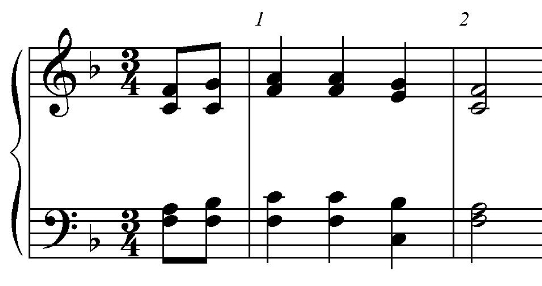
Now, let’s consider another example from the same song. Here is the first phrase. Note the I – V – I progression again.
Here is a solution for turning this progression into a I – ii – V – I progression.
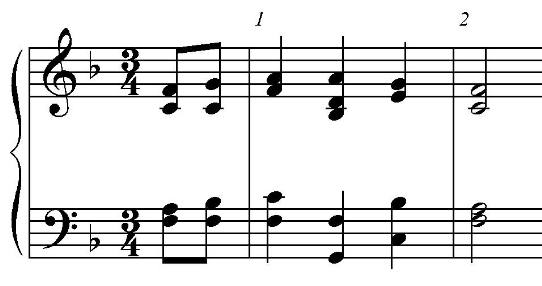
Note that I did not break up the V chord into ii – V in this example. I instead borrowed a beat from the I chord just in front of the V chord. This also works quite well.