
Free Lessons
Praise Him, Praise Him – A thought about functional harmony
I was playing “Praise Him, Praise Him” in church yesterday and noticed a great example of functional harmony at work. I mention these kinds of things because they will help you understand music better and as a result, play better.
These are the first two measures of the last line of the chorus. This is a four part harmony and the congregation is singing “Praise Him” once in each measure.
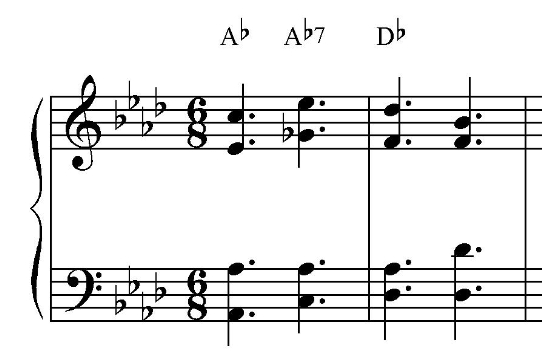
I wrote in the chords for you. Because we are in the key of Ab, Ab is the I chord and Db is the IV chord. Both are normally going to be major chords.
The I chord is normally a place of resolution in a song. You will often see the chord without the 7th or in some cases, with a major 7th (in this case, G) added. Both the I and IMaj7 function as a place for other other chords to resolve to. It is really irrevelant from a functional standpoint whether the major 7th is added or not.
Notice that the Ab chord changes to Ab7 in the second half of the first measure. A minor 7th (Gb) has been added rather than the major 7th. As a result, Ab is now a dominant chord. This is a very significant change because now the function of the Ab chord has changed. Rather than being a place of resolution, it has become a chord that needs to resolve somewhere else.
As it turns out, changing Ab to Ab7 creates what we call a secondary dominant. You can often recognize a secondary dominant when you see a dominant chord that is not the V chord. And when you see a secondary dominant, you can almost certainly assume that it is going to resolve down a fifth. In this song, it resolves down a fifth to Db which is the IV chord.
A few more thoughts: Changing the Ab to Ab7 was not necessary. The arranger could have just written Ab for the entire first measure and it would have worked. You see I – IV progressions in songs all of the time. However, the move from Ab to Ab7 to Db is smoother because it the Ab7 creates a strong need to resolve to the IV chord. It basically becomes a matchmaker or a glue between the I and the IV.
Here are a few caveats at this point because some theory experts are going to pick me apart. It is not necessary for dominant chords to resolve down a fifth. They also nicely resolve down a half step, and there is nothing to stop writers from moving from dominants to any other chord they want to. However, in the music you are going to play on a normal basis, you will almost always see dominants resolve down a fifth.
One other thing: Every dominant you see in your music that is not a V chord is not necessarily a secondary dominant. But we can discuss that at a later time.