
Free Lessons
Rootless voicings
Today’s lesson will be brand new to most of you. It covers rootless voicings, which is a technique used by pianists when they are accompanying other musicians or vocalists.
First of all, let’s define the terms. I talk a lot about voicing but in case you do not remember, voicing refers to the position on the keyboard where notes in a chord are played. Review this lesson for more information and examples.
When I say rootless, I mean playing chords without the root (bottom note of the chord). If you are playing a rootless C7 chord, you might play E, G, Bb. You can change those notes a bit as I will discuss in a minute.
Why would you play a rootless chord? The primary reason is stay out of the way of other instruments who are playing roots (such as a bass guitar, an upright bass, or even an organ). If they are playing the roots, you don’t have to.
Playing rootless voicings avoids conflicts with those instruments. After all, we are all trained to play inversions. If you need to play a C7 chord, a bass player is likely to play a C, E, or G. If you don’t know exactly what he is going to do, you may play a different inversion and clash with him. In a typical church service, this happens a lot between piano and organ or piano and bass guitar.
Rootless voicings are played around middle C in the left hand. Actually, you should try fitting them into the octave below middle C. In many cases, they will creep up into the octave above middle C. Let your ear be the guide as to the best place to position them. Just don’t go down low enough to conflict with the instruments playing bass.
Now, some of you are undoubtedly intimidated by this concept, but it is not as difficult as you think. There are essentially two different formulas for these voicings and they are sometimes referred to as A and B.
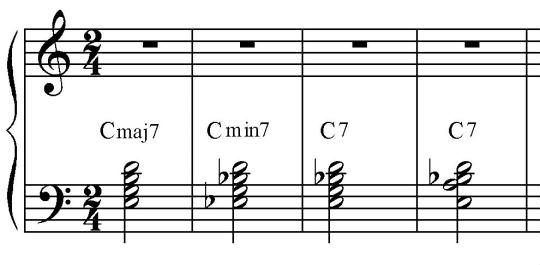
In A voicings, you play from bottom to top these notes:
Major 7th and Minor 7ths: 3, 5, 7, 9
Dominants: 3, 5, 7, 9 or 3, 13, 7, 9
For dominants, note that I gave you two options–including either the 5 or the 13 (6th). Using the 13 is more modern and interesting, but if you can’t bring yourself to do it, play the 5 instead.
Here are examples:
In B voicings, you play from bottom to top these notes:
Major 7th and Minor 7ths: 7, 9, 3, 5
Dominants: 7, 9, 3, 13 or 7, 9, 3, 5
Here are examples:
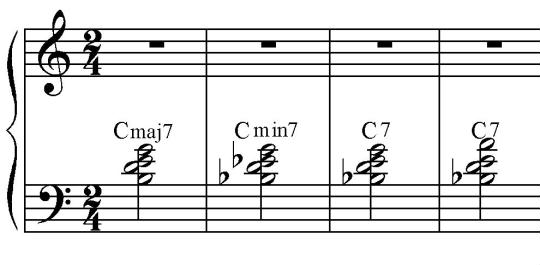
Note the position on the keyboard of these voicings. They are higher than the others, but do not sound right if you drop them down an octave. In general, keep all of the notes above the C below middle C.
As you can imagine, learning to play these voicings will take some time but not as much as you think. You have to get to the point where you play them instinctively for every chord.
So what do you do with the right hand? Anything you want–melody, patterns, counter melodies, whatever. We will talk about that at some other point.
What you will find is that if you play in this way, more things sound right. If I do not know a song well, I tend to play rootless and leave the critical roots to someone else. For example, if playing with a male quartet with a strong bass, I stay out of the way and let him sing roots. That keeps me from having to anticipate what inversions he is going to sing.