
Free Lessons
Why chords can be called different things
In my opinion, understanding music theory is critical if you plan to learn to improvise. If you are already improvising by ear, you can be successful for a long time without ever knowing anything about theory. However, in the long run, you will help yourself by learning the theory behind your music.
Over the next several months, I am going to be discussing improvisation from a theory prospective and I want you to be able to follow me. Today, I want to discuss how chords are named.
Normally, hymn chords are very simplistic. They are usually simple major or minor triads. In a hymnal, a lot of inversions are used to help smooth the lines for the singers’ parts. Some chords have the 7th added, and more rarely, you will see a diminished chord. Really, things do not get much more complex than that.
In a nutshell, hymn chords are boring, but we are going to eventually fix that with improvisation.
I would say that naming chords in hymns is simple except that two people can name chords differently and neither is wrong. Here is an example:
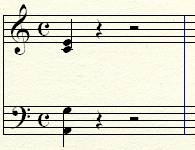
The above chord is often labeled as a C/A (I will cover “slash” chords like this later, but this means a C major chord with an A in the bass.) However, it is more correct to label this chord Am7. Slash chords are often used by musicians just to simplify chords that are more complex.
You might also see this slash chord written with numbers such as 1/6 or I/vi (Roman numerals). Because the key in the example is C major, the C chord is the 1 (or I) chord and the A in the bass is the 6th (or vi) note in the scale.
You might also see the Am7 written as A-7 or Amin7 or 6m7. They all mean the same thing.
Here is another example with a more complex chord:
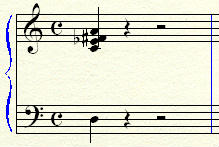
You will see this chord labeled as Cdim/D. (The “dim” stands for diminished, and if you are not familiar with this chord, don’t worry. We will cover it later.) On the other hand, I would label this one a D7(b9) (D major chord with a 7th and a flat 9th).
If you cannot understand this example, relax. It is a far more complex chord than you will see in any hymnal, and I will talk about it in much more detail later.