
Free Lessons
Choosing the right 7th for a chord
In the past, I have spent a lot of time talking about the importance of the 7th in your chords. Sevenths are not the end of where you need to go, but they are a huge start in the right direction.
One of the challenging things about using a 7th is choosing whether to use the major or minor 7th. As a refresher, the major 7th is a half step under the root. In a C chord, it would be B. The minor 7th is a whole step under the root, and in a C chord, would be a Bb.
So, which one should you use? It occurred to me recently that I can give a few simple rules to help you get started. These rules can be broken, but they are a great starting place.
- On minor chords, you will almost always use the minor 7th.
- On major chords that are either the I or IV chord, you will most often use the major 7th.
- If you are playing a major V chord, you will most often use the minor 7th (making the chord a dominant chord).
- If you find yourself playing a major chord that normally would be minor, you will probably use the minor 7th. This would include II, III, and VI chords. There is a specific reason why this is true that we will address later.
Let’s talk for a minute about why rules 2 and 3 work that way. Here are the I, IV, and chords in the key of C.
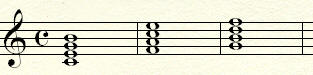
Note that I have added the 7th to each chord that naturally falls into the key. As it works out, the seventh that is natural for the I and IV chords is the major seventh, and it is natural for the V chord to have a minor 7th. This is true regardless of the key.
That being said, there will be exceptions. You will see dominant I chords for example. However, it is a good rule of thumb to follow these rules.
Here is one more little tip regarding using 7ths in congregational singing. When you choose between a major and minor 7th on a major chord (meaning you are choosing between a Maj7 chord and dominant chord), you are actually choosing how that chord will function. We will get into this in more detail later. The application, however is this. In my opinion (though your song leader may disagree), you can add major 7ths to chords when accompanying congregational singing without causing any problems. However, you should be careful not to turn major chords into dominant chords in that setting because that will cause the function of the chord to change.
Practice Strategy:
Pick a hymn and label all the major and minor chords in it. Then play it, adding the 7ths according to the rules above. Repeat this process for more hymns as you have time.