Free Lessons
Adding the 9th
As we continue working through “Take My Life,” I will be showing you potential color notes to add. Today, I want to give you a few specific voicings for adding the 9th.
Remember that the 9th is just a complicated way of saying the2nd. (you call it a 9th rather than a 2nd when a 7th is present in the chord.) The sooner you memorize that the 9th is the 2nd, the 11th is the 4th, and the 13th is the 6th, the better off you will be. In a C chord, the 9th is D, the 11th is F, and the 13th is A.
I need to take a moment and explain how we are going to go about this process. It may be overwhelming at first, but you can get it with practice.
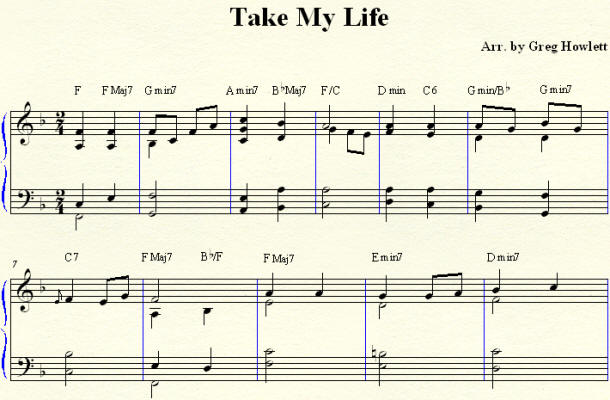
Remember that I have emphasized in previous lessons that you need to be able to analyze chords quickly. Now, we are going to make things a bit more complicated. Once you figure out the chord, you need to also identify how the melody note fits into that chord. Let’s look at the first phrase from “Take My Life”.
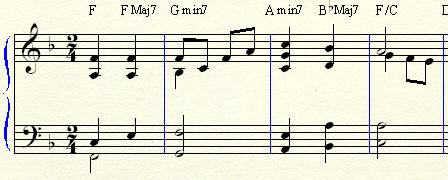
The first melody note is an F and the chord is F so the melody is also the root. However, in the first beat of measure 2, you are playing a G minor 7 and the melody note is F. F is the 7th of a G minor chord. In the first beat of measure 3, the melody note is the 3rd (C) of an A minor chord. In the first beat of measure 4, the A in the melody is the 3rd of the chord. Do you see how this works?
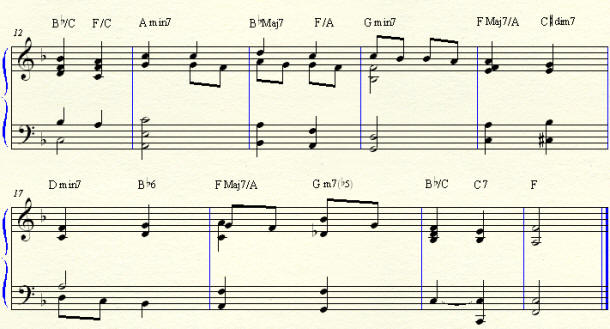
Now, take a moment to go through this hymn (see below) and circle all of the places where the melody note is the 3rd, 5th or 7th of the chord being played. I am going to show you simple voicings to add a 9th to all of those chords.
Before I start, let me emphasize that you can add 9ths in many other places than the three I am about to show you and you can add the 9th in different voicings from the ones I am about to show you. These are just simple by effective voicings that I use very often.
Here are the voicings:
| LH | RH | |
| Melody note is the 3rd |
1-5 | 7-9-3 |
| Melody note is the 5th |
1-7 | 9-3-5 |
| Melody note is the 7th |
1-5 | 9-3-7 |
So what does this chart mean The first row means that if the melody note is the 3rd of the chord, play the root and the 5th in the left hand and the 7th,
9th, and 3rd in the right hand. Here are the three voicings with a C chord.
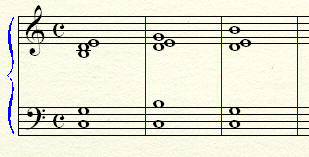
Note that using these voicings keeps you from doubling the root as most church pianists are prone to do. You end up substituting the 9th for the
root in the right hand, and that is a great trade.
Now look at “Take My Life” again and change the voicing for the chords you circled according to the chart above. In these voicings, you should keep your hands close together. You may find that these voicing do not always work for you in this song–if you do not like the way something sounds, don’t
play it.
While this may seem tedious at first, you will get to the point where you are using these voicings without even thinking about them.