
Free Lessons
The IV/V to V7 progression
My daughter who is five years old plays the violin, and I often write music for her and accompany her. Recently, I gave her a new melody to play and started playing an intro. I was a little surprised to see that she instinctively knew when to start playing. It could have been because she has heard me play so much and she knows what I am going to do. Perhaps I am just too predictable. However, I prefer to think that that she instinctively interpreted a progression I used as her entry point.
This week, I want to talk about that progression which is useful both as an entry point as well as in a modulation to a new key. Once you learn the progression, you will find yourself using it quite often.
First, let’s talk about the progression itself. Remember that when you see a IV/V chord, it means to play a IV chord with a V (fifth note) of that key as the bass. Here is an example.
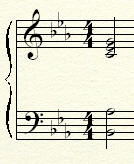
This is a Ab chord (with a optional major 7th) played over a Bb. Before I go further, I will mention that calling this chord a IV/V is a preference. Other musicians may call it something entirely different. I am choosing to call it that because it is easier to learn that way. I could name the chord in relation to the bass note, meaning that it would a V7 chord with a 9th, 11th and 13th. However, note that if I did that, the 3rd (D) would be missing, which happens to be a very important note in a dominant chord. So, in this setting, I think the IV/V label is really better.
That being said, the IV/V chord leads very naturally to the V7 which leads to the I chord. Play this progression and notice what I mean.
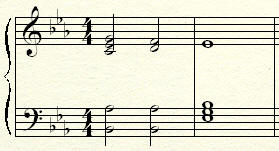
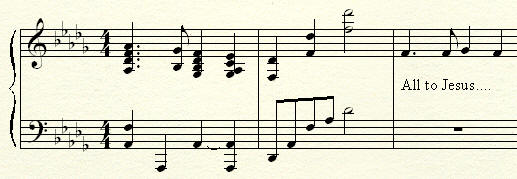
Now, let’s analyze this progression for a moment by comparing it with an example of a more traditional approach. It has been more common in church music to end introductions with the I chord. Here is a typical introduction for “I Surrender All.” Notice the typical use of the I chord in the second measure.
Now, here is an introduction with the IV/V to V7 progression. The IV/V – V7 progression is the last two beats of the second measure.
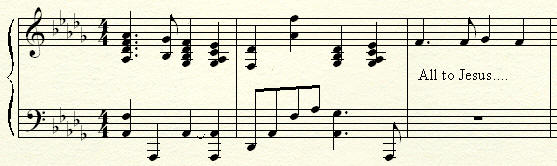
So what is the difference? In my opinion, the difference is about movement. The first example has no movement while the second feels like it is going somewhere. The movement is coming from the dissonance in the chords. The V7 chord desperately wants to resolve because of its inherent dissonance. The IV/V chord is even dissonant and resolves to the V7.
So when can you use this progression? Here are afew ideas.
- During a modulation. (I will give more details on this next week.)
- At the end of an introduction rather than a I chord.
- Between verses of a song.
- Within the verse of a song between phrases
- Within a phrase itself as a substitute progression. (For example, you can change a V7 – I cadence to a IV/V – V7 – I.
Practice Strategy:
Learn how to play the IV/V – V7 progression in every key. If you invest ten minutes a day, you will have this down in a week. Also, pick a hymn and learn how to incorporate this progression in the five ways I mention above. (If you do not know how to modulate yet, ignore that one for now.)