
Free Lessons
Modulation between keys
I have gotten many requests to post a lesson on how to modulate between keys. More and more churches are starting to either package songs together or change keys within a song, so modulation is becoming a necessity for church pianists.
Modulation can be done in many ways, but today, I want to talk about it a bit from a theory standpoint and give you a formula you can use in every situation.
Last week, I talked about how the V7 naturally resolves to the tonic. Because of that, modulating can be as easy as finding a way to the V7 chord in the new key. I cannot emphasize how much that is true. If you do not know the V7 chords in every key, you need to learn them. Practice going from V7 to I in every key for a few days and you will know this progression in no time.
Remember also from last week that we talked about setting up the V7 chord with a IV/V chord? The IV/V chord is also a great chord to use in a modulation
progression, and it is usually proceeded by the minor ii chord.
So, here is the progression so far:
ii – IV/V – V7 – I (All of these chords should be played in the new key.)
Take some time to practice these progressions at least in the keys that most church hymns are played in (C, Db, D, Eb, F, G, Ab, Bb). Here is the progression in the key of F.
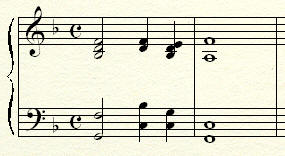
Now that you know this progression, we need to know how to set it up within a modulation. In other words, how do you actually get to the minor ii chord in the new key? That is where things get a bit tricky, but one solution is to play the vi chord in the old key. Playing a vi chord moves the harmony enough away from the tonal center that you can easily move on to the minor ii chord in the new key. That being said, the vi chord is certainly not the only chord you can use
to do this.
If you do use this entire progression, it looks like this:
| Old Key |
New Key |
| I – vi | ii – IV/V – V7 – I |
If you are going from F to G, the chords would be:
F – Dmin – Amin – C/D – D7 – G
Now that you know the formula, there is only one more thing to learn–how to make the transition sound beautiful and natural. Unfortunately, this is the hardest part and something that is very hard to really teach. However, here are some thoughts.
- Feel free to eliminate chords from the formula if you want. Often, they are not all necessary.
- Try to incorporate either the melody of the song or perhaps another melody line into the progression (see example below).
- Change the inversions of the chords to smooth out the bass line.
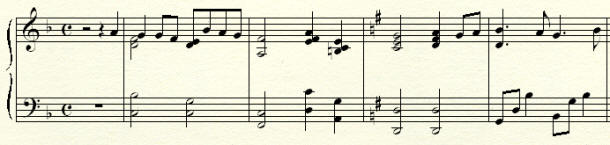
Now, I want to give a quick example of changing keys between verses of “At the Cross.” While this modulation follows the progression perfectly, it is not what
you want to do because it just does not sound good:
Here is the same chord progression played in a way that makes more sense.
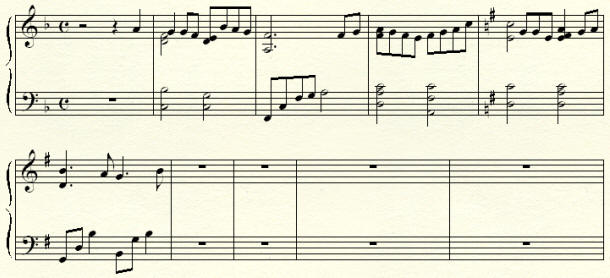
Let me emphasize a few things. First, I want to repeat that while this is a universal modulation formula, I do not mean to imply that it is the only way to do it. Next week, I will start giving you other modulation formulas for specific situations.
Secondly, understand that you have to practice to really get good at this. Practice the progression itself, but more importantly, practice keeping an interesting melody line throughout the progression.
Practice Strategy:
Pick two keys at random and practice the progression to modulate from one to another. Then try it with a few songs, incorporating the melody line from either song into the modulation progression. Work with other keys and songs as you have time.